
Forest Land Property Tax Programs For Landowners
Keep your growth up and your taxes down with this comprehensive list of timber tax subsidy programs by state
Property tax relief for forest landowners exists in nearly every state, with programs offering 25-80% tax reductions through current use assessment. These programs allow landowners to be taxed on their land’s forestry productivity value rather than its development potential, creating significant annual savings while supporting forest conservation. Understanding your state’s specific requirements for minimum acreage, management plans, and application deadlines is critical to accessing these benefits.
Forest land tax programs originated in the 1960s-70s as states recognized that taxing forestland at market value was forcing landowners to sell for development. Today, these programs protect millions of acres while providing landowners with predictable, lower tax bills. However, each state structures its program differently—some require as little as 2 acres while others demand 200 acres; some need detailed management plans while others simply require a forester’s report. The application process, covenant periods, and penalty structures also vary substantially, making state-specific knowledge essential for landowners considering enrollment.
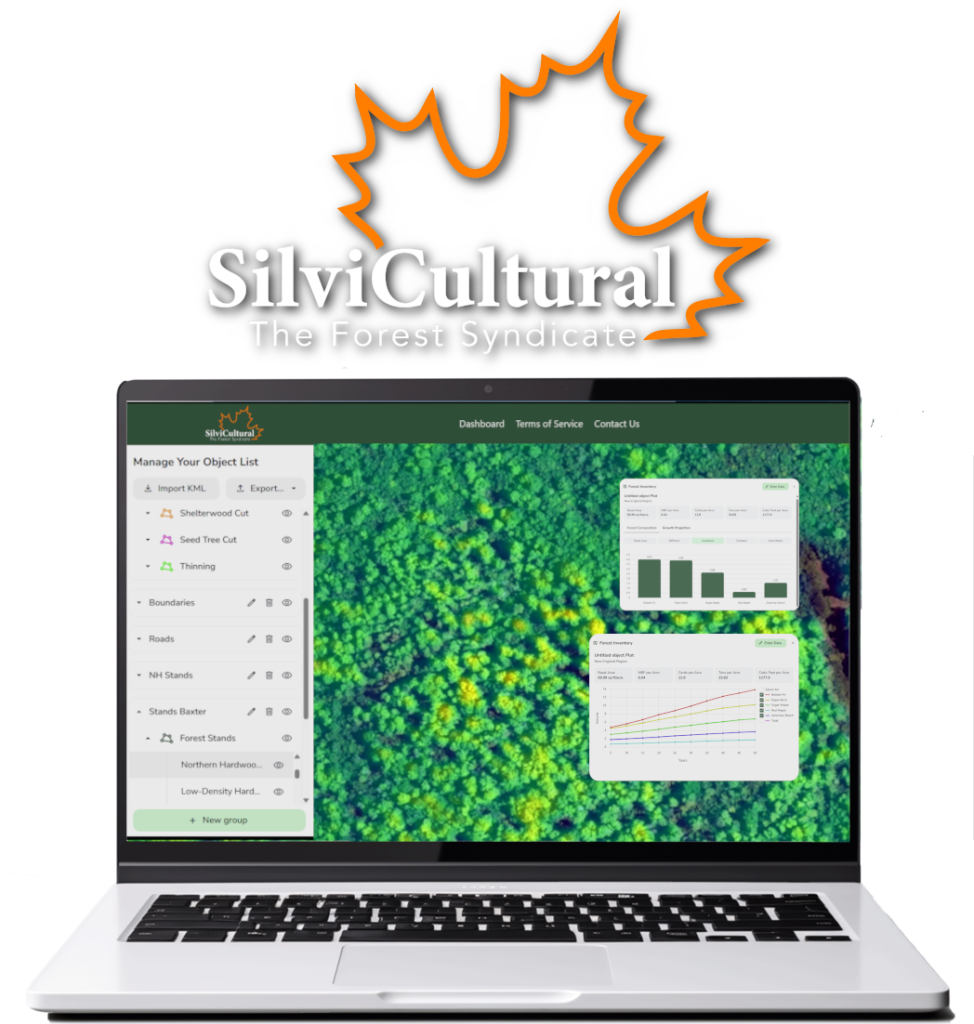
Comprehensive Forest Management in One Place
SilviCultural provides everything you need to turbocharge your forest management all in one place
- Online Mapping And GPS Map Creation
- High Resolution LiDAR and Multispectral Imagery
- Cruising and Inventory Analysis
- Forest Growth Projection
- Sustainable Harvest Planning
- AI Forest Management Assistance
NORTHEAST PROGRAMS
The Northeast offers some of the nation’s most established forest tax programs, with minimum acreage requirements ranging from 5-50 acres and all states requiring some form of management planning. Maine’s program delivers an average 70% tax savings, while New York provides up to 80% exemption. Most northeastern states operate on similar principles—assessing land at productive use value rather than development value—but differ significantly in their management requirements and penalties.

Maine: Tree Growth Tax Law
Maine operates one of the most generous forest tax programs in the nation through its Tree Growth Tax Law, administered by the Maine Forest Service. The program provides an average 70% property tax savings by valuing land based on its ability to grow trees rather than its highest and best use or fair market value.
Eligibility requires 10 acres minimum of forest land managed primarily for commercial forest products production. Landowners must develop a Woodland Resource Action Plan (WRAP) or forest management plan prepared by a licensed forester. The land must be capable of growing trees and committed to forestry use, following the plan’s management prescriptions.
The application deadline is April 1 to qualify for the current tax year. Applications are filed with the local tax assessor along with the approved management plan. Both the Maine Forest Service and local assessor review applications before approval. There is no enrollment fee, but landowners must recertify every 10 years. Maine offers cost-share programs that pay 50% of forest management plan development costs, plus a $200 tax credit every 10 years specifically for plan development.
Withdrawal carries significant penalties: rollback taxes for the period from last certification or preceding 5 years (whichever is longer), plus a conveyance tax of 10% of property value in year one of classification, declining 1% per year for 10 years. Contact the Maine Forest Service here or your local District Forester.
New Hampshire: Current Use Assessment
New Hampshire’s Current Use Assessment program under RSA 79-A provides substantial tax relief by assessing properties at productive capacity rather than real estate development value. The New Hampshire Department of Revenue Administration manages program oversight here, while applications are processed through municipal tax assessors.
Forest land requires 10 acres minimum, with enhanced benefits available for “Forest Land with Documented Stewardship” requiring certification as a Tree Farm, SFI or FSC certification, or a management plan prepared by an NH licensed forester on Form CU-12. Current use values are set annually by the Current Use Board, with 2012+ forest land values ranging $135-$225 per acre depending on grade, location, and site quality. An additional 20% Recreational Adjustment discount applies if land is open to the public for hunting, fishing, snowshoeing, hiking, skiing, and nature observation.
Applications are filed with the municipal tax assessor by April 15 for that tax year using Form A-10. Once enrolled, no annual renewal is required—the assessment continues automatically. For documented stewardship categories, landowners must recertify every 10 years. A one-time 10% land use change penalty applies if the use changes. Contact the NH Department of Revenue Administration at (603) 230-5950 or cub@dra.nh.gov. Additional guidance is available through UNH Cooperative Extension here.
Vermont: Use Value Appraisal Program
Vermont’s Use Value Appraisal (UVA) Program, also known as Current Use, assesses eligible forest land at $203 per acre (2025 rate) rather than fair market value. The Vermont Department of Taxes administers the program here, while the Department of Forests, Parks & Recreation handles forest management plan approvals.
Eligibility requires 25 contiguous acres minimum for managed forestland. A forest management plan prepared by a licensed consulting forester is mandatory, must be approved by the Department of Forests, Parks and Recreation, and updated every 10 years. Properties are inspected at least once every 10 years, with site reviews required every 5 years.
Applications must be submitted by September 1 for enrollment using Form CU-301, including three copies of mapping meeting program standards and a $100 application fee (Form CU-307). Ongoing requirements include submitting a Forest Management Activity Report (FMAR) by February 1 for any management activity. A 10% land use change tax on fair market value applies if land is developed. Contact the Vermont Department of Taxes at 802-828-5860 ext. 2 or tax.currentuse@vermont.gov.
Massachusetts: Chapter 61 Forest Land Classification
Massachusetts offers its Chapter 61 program for forest lands, with related Chapter 61A (agricultural) and 61B (recreational) options. The program is governed by MGL Chapter 61 and administered by the Massachusetts Department of Conservation and Recreation, with property tax information here.
Properties must include 10 contiguous acres minimum for forest land classification. Forests must meet minimum stocking requirements of 16.7% or 500 trees per acre. A 10-year forest management and cutting plan certified by the State Forester is required. The assessment structure is unique: land is assessed at 5% of Fair Market Value plus an 8% yield tax on harvested timber.
Applications must reach the State Forester by July 1 for certification, then evidence of certification and the approved plan must be submitted to local assessors before September 1. Recertification is required every 10 years. Withdrawal triggers rollback or conveyance taxes (whichever is greater). Notably, municipalities have a right of first refusal to purchase if land is sold for non-forest use. Contact the Bureau of Forestry for forest management plan certification or call the MA Department of Agricultural Resources at (617) 626-1704.
Rhode Island: Farm, Forest, and Open Space Act
Rhode Island’s Farm, Forest, and Open Space Act (FFOS) provides current use assessment for forest lands through the RI Department of Environmental Management here.
Forest land must comprise 10 acres minimum (excluding house site) and bear dense growth of trees including young regenerating forest. A Forest Stewardship Plan prepared by a qualified forester is required, must be approved by DEM, and address minimum criteria established by regulations. The 2023+ assessed value is $115 per acre.
Applications are submitted through the DAFE Online Permit Application Portal with a $10 application fee. Site reviews occur every 5 years by DEM. Plans must be updated every 10 years. Annual affirmation forms are due January 31. A 10% land use change tax on fair market value applies if withdrawn in the first 6 years, decreasing 1% per additional year after year 6. Contact Forest Stewardship Program Coordinator Fern Graves at 401-539-2356 ext. 2.
Connecticut: Public Act 490
Connecticut’s Public Act 490 (PA 490), the state’s Current-Use Tax Law for Farm, Forest and Open Space Land, is administered through CT DEEP Forestry and the CT Department of Agriculture.
Forest land requires one tract of 25+ contiguous acres, two or more tracts aggregating 25+ acres (no single tract less than 10 acres), or any tract contiguous to the owner’s already-classified forest land. A Qualified Forester’s Report prepared by a PA 490 certified forester is required. The 2025 recommended forest land value is $200 per acre (for town-wide revaluations after October 1, 2025).
Applications using Form M-39 must be filed with the local tax assessor between September 1 and October 31, including the Qualified Forester’s Report. In revaluation years, the deadline extends to December 30. Classification is personal to the owner and does not transfer with land sale. A conveyance tax of 10% of sale price or fair market value applies in year one upon withdrawal, declining 1% per year for 10 years. Contact CT Farm Bureau at 860-768-1100 or visit them here.
New York: Forest Tax Law (Section 480-a)
New York’s Forest Tax Law Program under Real Property Tax Law Section 480-a provides substantial property tax relief for larger forest holdings. The NY DEC administers the program.
The program requires 50 contiguous acres minimum of forest land. A forest management plan prepared by a professional forester and approved by DEC is mandatory, including a 15-year work schedule updated every 5 years. Owners commit to a 10-year management period with annual recommitment.
Tax benefits include exemption of up to 80% of assessed value OR exemption equal to the amount by which assessed value exceeds ($40 × latest state equalization rate), whichever is lesser. The exemption continues annually with yearly recommitment.
Submit applications to DEC Regional Foresters by December 31. Annual commitment forms must be filed each year with both the Town Assessor and DEC Regional Forester. Give DEC 30 days notice before cutting and pay 6% stumpage tax to the County Treasurer within 30 days of DEC value certification. Non-compliance penalties are severe: 2.5 times tax savings plus interest for up to the past 10 years. Contact regional DEC forestry offices listed at the program website.
Pennsylvania: Clean and Green Program
Pennsylvania’s Farmland and Forest Land Assessment Act of 1974 (Act 319), known as the Clean and Green Program, is one of the nation’s most accessible forest tax programs. The PA Department of Agriculture administers it here.
Only 10 acres minimum is required. Forest Reserve land must be devoted to production of timber or wood products. Notably, no formal management plan is required, unlike most other states. Assessment is based on use value rather than fair market value. The program delivers an average 50% reduction in property assessment.
Application deadline is June 1 each year (for the following tax year), extended to October 15 in years of countywide reassessment. The entire tax parcel must be enrolled—no partial parcel exclusions are permitted. Once enrolled, no annual reapplication is required.
Rollback tax penalties include 7 years of rollback taxes at 6% interest per year if use is changed. Split-offs are allowed: up to 2 acres/year (maximum 10 acres or 10% of total, whichever is less) for residential use. Contact PA Department of Agriculture Clean and Green Administrator Christopher Snyder at 717-257-6532 or 717-705-7796.
New Jersey: Farmland Assessment Act
New Jersey’s Farmland Assessment Act of 1964 (with 1986 amendments covering woodland) provides use value assessment for agricultural lands including forests. The NJ Division of Taxation provides information at https://www.nj.gov/treasury/taxation/lpt/lpt-farmland.shtml, while the NJ Forest Service offers guidance here.
Generally, 5 acres minimum devoted to agricultural/horticultural use qualifies, but for woodland exceeding 50% of total property, a Woodland Management Plan or Forest Stewardship Plan is required. Plans must be prepared by an approved forester and certified by NJ DEP. Land must be “actively devoted” to agricultural/horticultural use for 2 successive years prior to application.
Applications must be filed with the municipal tax assessor by August 1 using Form FA-1, FA-1 G.S., and Form WD-1 (Woodland Data Form) for woodland. First-year applications must include a copy of the Woodland Management Plan or Forest Stewardship Plan. Annual filing is required. NJ Forest Service inspects sites every 3 years. Rollback tax equals 3 years if use changes. Contact NJ Division of Taxation at 609-984-2503 or NJ Forest Service at 609-292-2531.
APPALACHIAN PROGAMS
Appalachian states balance conservation goals with practical accessibility, generally requiring 10-20 acres and offering use value assessment that defers significant taxes while land remains enrolled. Most programs require forest management plans updated every 10 years, with rollback periods of 3-5 years upon withdrawal.
West Virginia: Managed Timberland Tax Incentive Program
West Virginia’s Managed Timberland Tax Incentive Program provides current use assessment for actively managed forest lands. The West Virginia Division of Forestry administers the program at https://wvforestry.com/management-assistance/managed-timberland-program/.
Eligibility requires 10 contiguous wooded acres minimum with at least 40% normal stocking of commercially valuable tree species. A management plan is required: owners may either file a notarized document stating land is being protected and managed OR submit a plan prepared by a professional forester.
Land is divided into three productivity grades: Minimum values for Class III/IV properties: $225/acre (Grade 1), $150/acre (Grade 2), $75/acre (Grade 3); Class II properties: $200/acre (Grade 1), $140/acre (Grade 2), $50/acre (Grade 3).
Initial contracts are due before July 1. Annual Certification applications must be submitted between March 1 and September 1. Online renewal is available as of October 1, 2023. If the director determines the owner failed to implement the certified plan, the owner must pay property taxes saved plus 9% annual interest. Contact the West Virginia Division of Forestry at (304) 558-2788.
Virginia: Use-Value Assessment Program
Virginia’s Use-Value Assessment Program covers agricultural, horticultural, forestry, and open space lands. The program is authorized under Virginia Code §58.1-3230 through §58.1-3240, with support from the Virginia Department of Forestry.
For forestry use, 20 acres minimum is required (excluding one-acre house site). Forest land must have at least 40% normal stocking of commercially valuable trees. A forest management plan is required and must be updated every 10 years.
Land is taxed at “use value” rather than fair market value. Forest parcels do not require income verification for revalidation, unlike agricultural properties.
Application deadline is November 1 of the year preceding the desired tax reduction year. Late applications accepted November 2 through December 1 with a $25-$50 late fee. Initial application fees range $10-$100 (commonly $50-$100). Annual revalidation using Form LU-2 is required by November 2. Rollback taxes for current year plus 5 preceding years plus interest become due if property no longer qualifies. Contact the Virginia Department of Forestry at (434) 220-9021 or conservation@dof.virginia.gov.
Kentucky: Agricultural/Horticultural Land Use Valuation
Kentucky includes timber production under its Agricultural/Horticultural Land Use Valuation program. The Kentucky Department of Revenue provides information here.
A minimum of 10 contiguous acres qualifies, with timber production included under agricultural land definition. Timberland does not have specific income requirements (unlike cropland requiring $1,000 average annual income over 3 years).
Land is assessed at “use value” based on income-producing capability. Kentucky does not have a separate forestry valuation category—timber is included under agricultural land. Application deadline is March 1. No annual revalidation is typically required unless ownership changes. Kentucky does not have a timber severance or yield tax. Contact your local county Property Valuation Administrator.
Tennessee: Greenbelt Program
Tennessee’s Greenbelt Program, established under the Agricultural, Forest and Open Space Land Act of 1976, provides present-use value assessment. The Tennessee State Board of Equalization administers the program.
Forest land requires 15 acres minimum. A forest management plan is required, though professional foresters are advised but not required. Forest land has no specific income requirement.
Land is valued based on “present use” rather than “highest and best use.”
First-time applications must be filed by March 15 with the County Assessor. Late applications accepted within 30 days with a $50 late fee. Reapplication is not required unless ownership changes. Forest land faces 3-year rollback (current year plus 2 preceding years) if disqualified. Contact the State Board of Equalization at sb.web@cot.tn.gov.
North Carolina: Present-Use Value Program
North Carolina’s Present-Use Value (PUV) Program for Forestland provides substantial tax savings. The NC Forest Service administers forestry aspects, while the NC Department of Revenue oversees the broader program.
At least one tract must be minimum 20 acres in actual production. A written forest management plan is required, which can be prepared by a professional forester or the landowner if qualified.
Land is taxed at “present-use value” using a 9% capitalization rate, with tax savings potentially reaching up to 90% in some cases. Standing timber, pulpwood, seedlings, saplings, and other forest growth are excluded from taxation.
Applications must be filed with the county assessor during the regular listing period or within 30 days of notice of change in valuation. The difference between present-use tax and market value tax is carried as “deferred tax” with a 3-year rollback period. Since 2010, properties with conservation easements on PUV acreage can continue without income requirements. Contact the North Carolina Forest Service or your county tax assessor.
SOUTHEAST PROGRAMS
Southeastern states demonstrate the region’s agricultural heritage with forest tax programs that frequently have no minimum acreage requirements or very low thresholds (2-10 acres). Most Southeast programs assess at 4-20% of use value with annual per-acre fees ranging $0.08-$0.20, and several states exempt standing timber entirely from ad valorem taxation.

South Carolina: Agricultural Use Property Classification
South Carolina provides property tax relief through its Agricultural Use Property Classification with Special Assessment Ratio, administered by the South Carolina Department of Revenue.
Timberland tracts must be 5 acres or more. Property must be devoted to growing trees for commercial use and “actually used” for agricultural/forestry purposes as of January 1.
The assessment ratio is 4% for individuals, partnerships, and qualifying corporations (versus 6% standard), resulting in savings of more than one-third of the tax bill. Values are frozen at 1991 tax year levels. Standing timber is exempt from ad valorem taxation.
Applications must be filed before January 15 with the county assessor’s office. No annual re-application is required once approved. If property changes to non-agricultural use, rollback taxes for the year of change plus preceding 3 tax years become due. Contact the South Carolina Department of Revenue or your local county assessor.
Georgia: Forest Land Protection Act
Georgia’s Forest Land Protection Act of 2008 (FLPA) provides a 15-year covenant-based property tax exemption. The Georgia Department of Revenue administers the program.
Eligibility requires 200 acres minimum in aggregate, with parcels of at least 100 acres within any given county. At least 50% of property must be used for qualifying timber purposes.
The 15-year covenant provides ad valorem tax exemption, potentially resulting in 25-75% tax reduction depending on location. Residences are taxed separately at normal rates.
Applications including covenant agreements must be filed with the local county board of tax assessors. Breach penalties are severe: double the amount saved for every year of covenant plus interest. Contact the Georgia Department of Revenue.
Florida: Greenbelt Law
Florida’s Greenbelt Law is one of the nation’s most accessible forest tax programs. The Florida Department of Revenue provides information, with statutory authority under Florida Statute 193.461.
There is no official state-mandated minimum acreage requirement—generally 10+ acres is considered viable for commercial forestry. A written forest management plan is required for forestry operations. Property must be in agricultural use as of January 1.
Property is assessed at current use value rather than fair market value, with significant tax savings possible.
Complete Form DR-482 and submit to the county Property Appraiser by March 1. Once granted, classification automatically renews annually—no annual re-application is required. Florida has no state severance or yield tax on timber. Contact the Florida Department of Revenue or your county Property Appraiser.
Alabama: Current Use Valuation
Alabama’s Current Use Valuation provides one of the nation’s lowest property tax burdens for forest landowners. The Alabama Department of Revenue administers the program.
There is no specified minimum acreage, though parcels of 5 acres or less may require site management plans from Alabama Forestry Commission. Class III property is assessed at 10% of current use value. Alabama has some of the lowest property taxes in the nation (0.39% effective rate).
File written applications with the county Revenue Commissioner between October 1 and January 1. Once granted, no re-application is required. A $0.10 per acre annual tax is paid to the state. Rollback period is 3 years if property is converted to non-qualifying use. Contact the Alabama Department of Revenue.
Mississippi: Use Value Assessment
Mississippi’s Use Value Assessment includes timber production under agricultural use. The Mississippi Department of Revenue provides information, while the Mississippi Forestry Commission offers forestry guidance.
No specific minimum acreage is stated. Forest land is assessed at 15% of use value (Class II property). All growing, standing timber, trees and shrubs are exempt from all ad valorem taxes.
File applications with the county tax assessor. A Forest Acreage Tax of $0.09 per acre applies annually (due October 15). 80% of severance tax funds the Forest Resource Development Program for cost-share assistance.
Additional programs include the Mississippi Reforestation Tax Credit: 50% state income tax credit for reforestation costs with a maximum $75,000 annually. Contact the Mississippi Department of Revenue or Mississippi Forestry Commission at (601) 359-1386.
Louisiana: Use Value Assessment for Timberland
Louisiana’s Use Value Assessment provides substantial property tax relief with permanent applications in most parishes. The Louisiana Department of Revenue provides oversight.
No specific minimum acreage requirement is stated. Timberland is assessed at 10% of use value rather than fair market value.
File applications with the parish assessor. As of January 1, 2000, applications are permanent (except Orleans and Jefferson Parishes). A Forest Protection Tax of $0.08 per acre applies annually. As of June 24, 1998, local taxing jurisdictions are prohibited from imposing property tax on timber.
Contact the Louisiana Department of Revenue or parish assessor offices through the Louisiana Assessors’ Association.
Arkansas: Agricultural Use Valuation
Arkansas provides constitutional protection for forest land taxation through Amendment 59. The Arkansas Department of Finance and Administration provides information.
No specific minimum acreage requirement exists. All agricultural lands including timberland receive special classification. Assessment rate is 20% of use value.
Assessment is administered by county assessors. Property tax payment deadline is October 15 annually. A Forest Fire Protection Tax of $0.20 per acre funds the statewide forest fire protection program. AMD 79 caps assessed value increases at 10% annually.
Contact the Arkansas Department of Finance and Administration or the Arkansas Department of Agriculture – Forestry Division at (501) 225-1598.
PACIFIC NORTHWEST PROGRAMS
Pacific Northwest states have developed sophisticated forest tax systems recognizing the region’s timber economy, offering landowners choices between different tax structures. Washington, Oregon, and Idaho provide options between paying lower annual property taxes with harvest taxes, or higher annual taxes without harvest taxes, while Alaska maintains a simpler structure with automatic timber exemption.

Washington: Designated Forest Land Program
Washington’s Designated Forest Land Program provides current use assessment paired with timber excise tax at harvest. The Washington Department of Revenue administers the program with statutory authority in RCW 84.33.
Minimum acreage is 5 contiguous acres. A forest management plan may be required by the assessor, demonstrating compliance with forest practice laws. Land must comply with restocking provisions requiring 190 or more vigorous, undamaged commercial species seedlings per acre.
Land is valued at “current use” rather than “highest and best use.” Timber on Designated Forest Land is EXEMPT from real property taxes but subject to 5% timber excise tax at harvest, with the first 25,000 board feet harvested annually excluded.
Obtain applications from county assessors and submit by December 31. Application fees vary by county ($300-$625). Properties are subject to forest fire protection assessments (up to $7.50 + $0.15/acre over 50 acres). Compensating tax is due upon removal (maximum 9 years). Contact Washington Department of Revenue at 360-534-1400 or visit https://dor.wa.gov.
Oregon: Forestland Special Assessment and Small Tract Forestland Programs
Oregon offers two distinct forest tax programs. The Oregon Department of Revenue administers both with statutory authority in ORS 321.
Forestland Program requires at least 2 acres for designated forestland. Must meet Oregon Forest Practices Act stocking standards, with 20% (minimum 2 acres) meeting standards by December 31 of first assessment year. Land is assessed at special value based on typical price for forestland managed for timber production. Forest Product Harvest Tax (FPHT) applies at harvest, with first 25 MBF (thousand board feet) excluded annually.
Small Tract Forestland (STF) Program requires at least 10 acres but fewer than 5,000 acres. All contiguously owned properties must be enrolled. Provides annual property tax on only 20% of forestland special assessment value (80% deferred). STF Severance Tax due at harvest to recover deferred 80%.
Contact county assessor and submit applications between January 1 and April 1. Application fees vary by county (typical: $75 + $5/acre for Forestland; $0 for STF). Forestland may owe back taxes for up to 5 years if disqualified; STF for up to 10 years. Contact Oregon Department of Revenue at 503-378-4988 or visit https://www.oregon.gov/dor/timber.
Idaho: Forest Land Exemption
Idaho’s Forest Land Exemption offers two designation options allowing landowners to choose their tax structure. The Idaho State Tax Commission provides information at https://tax.idaho.gov with statutory authority in Idaho Code Title 63, Chapter 17 at https://legislature.idaho.gov/statutesrules/idstat/Title63/T63CH17/.
Minimum is 5 contiguous, fully-stocked acres (6 acres if residence on property). Properties 5 to less than 5,000 acres may choose either option; 5,000+ acres MUST use Land Productivity Option. Written management plan reviewed by professional forester is required, including eventual harvest of forest crop.
Two designation options:
Option 1: LAND PRODUCTIVITY (LP) – Pay taxes annually on assessed land value PLUS projected annual growth. NO yield tax at harvest. NO deferred tax at sale/removal. Assessed value 29-48% HIGHER than Bare Land & Yield option.
Option 2: BARE LAND & YIELD TAX (BLY) – Pay annual taxes on bare land value only (29-48% LOWER than LP). 3% yield tax on stumpage value due at harvest. Deferred tax may be due at sale/removal/designation change (up to 10 years).
Three productivity classes: Poor (125 board feet/acre/year), Medium (225 board feet/acre/year in Zones 1-2), Good (350 board feet/acre/year in Zones 1-2).
Submit Form FT-101 with forest management plan to County Assessor by December 31. On-site inspection required prior to approval. Can change designation every 10 years on cycle (next opportunities: 2032, 2042). Must notify assessor within 30 days of any substantial change in use. Plans require updates approximately every 5-10 years. Contact county assessors (examples: Kootenai County 208-446-1526, kctimberag@kcgov.us). Idaho Department of Lands provides private forestry specialist assistance at https://www.idl.idaho.gov/forestry/.
Alaska: No Formal Forest Land Tax Reduction Program
Alaska does NOT have a specific forest land property tax reduction or exemption program comparable to other Pacific Northwest states. Under Alaska Statute 29.45.030(a)(9), materials laid down by natural process including TIMBER are exempt from taxation. This exemption applies automatically—no application, qualification process, minimum acreage, management plan, or enrollment fees required.
Property taxes are administered entirely at LOCAL level (boroughs and cities) with no state-level property tax. Many rural areas have no property tax at all. Average effective property tax rate is 1.16% (median $2,422/year based on median home value of $232,900).
Alaska Department of Commerce provides property tax information at https://www.commerce.alaska.gov/web/dcra/LocalGovernmentResourceDesk/TaxationAssessment/PropertyTax.aspx. Contact local borough/city assessor offices for property tax information (examples: Anchorage Municipality, Fairbanks North Star Borough 907-459-1428, website https://www.fnsb.gov/166/Real-Property-Assessment-Tax-Information).
Important notes for Alaska landowners: No active management required; timber exemption applies automatically; property tax rates vary widely by location; many rural areas have NO property tax; Alaska does not impose harvest or yield taxes on timber; always verify local property tax policies with borough/city assessor as Alaska’s decentralized system means practices vary considerably.
Key program comparisons and considerations for landowners
Understanding the variations among state programs helps landowners make informed decisions about enrollment and management strategies. Several critical factors distinguish programs across regions.
Minimum acreage requirements vary dramatically: Florida, Alabama, Mississippi, Louisiana, and Arkansas have no statutory minimums, making them highly accessible for small woodland owners. Oregon’s standard Forestland Program requires only 2 acres—the lowest specific minimum. Most Northeastern and Mid-Atlantic states require 10 acres (Maine, NH, MA, RI, PA, NJ), though Vermont demands 25 acres, Connecticut 25 acres, and New York 50 acres—the highest requirement nationally. Appalachian states cluster at 10-20 acres. Georgia stands out in the Southeast with a 200-acre aggregate minimum, reflecting its focus on larger commercial operations.
Management plan requirements reflect different program philosophies: Most states require formal forest management plans prepared or reviewed by professional foresters, updated every 5-10 years. Pennsylvania and Kentucky are notable exceptions—PA’s Clean and Green requires no management plan for Forest Reserve classification, while Kentucky includes timber under broader agricultural use without specific forestry plan requirements. Connecticut requires only a Qualified Forester’s Report rather than an ongoing management plan. Alaska requires nothing. States with mandatory plans typically provide cost-share assistance or technical support through extension services to offset plan development costs.
Tax benefit structures fall into several categories: Most states use straightforward current use assessment, valuing land based on productive forestry capability rather than development potential (Northeast, Appalachia, Southeast). Massachusetts employs a hybrid approach: 5% of fair market value plus 8% yield tax at harvest. Pacific Northwest states offer sophisticated dual-track options—Washington provides current use assessment with 5% timber excise tax at harvest; Oregon allows choice between standard Forestland (with harvest tax) or Small Tract Forestland (20% annual assessment on 80% deferred value with severance tax); Idaho offers Land Productivity (higher annual with no harvest tax) versus Bare Land & Yield Tax (lower annual with 3% harvest tax). Assessment ratios range from 4% (South Carolina) to 20% (Arkansas) of use value where specified.
Application timing requires careful attention: Most programs have strict annual deadlines. Common patterns include: November deadlines (Virginia), early spring deadlines (March 1 for Kentucky, Tennessee; March 15 for Tennessee; April 1 for Maine; April 15 for New Hampshire), late spring deadlines (June 1 for Pennsylvania), summer deadlines (August 1 for New Jersey), and fall deadlines (September 1 for Vermont; September 1-October 31 for Connecticut; October 1-January 1 for Alabama; December 31 for Washington, New York, Idaho). Florida’s March 1 deadline and Oregon’s January 1-April 1 window provide moderate flexibility. Missing deadlines typically means waiting a full year for the next enrollment opportunity.
Annual fees and ongoing costs vary significantly: Some states charge no enrollment fees (Maine, New Hampshire, Vermont has $100, Rhode Island $10). Others charge county-specific fees ranging from modest ($10-$100) to substantial ($300-$625 in some Washington counties). Annual per-acre fees for forest protection or forestry programs are common: Arkansas ($0.20/acre), Alabama ($0.10/acre), Mississippi ($0.09/acre), Louisiana ($0.08/acre), and Washington (up to $7.50 + $0.15/acre over 50 acres). These fees fund state forest fire protection and forestry support services. New York requires 6% stumpage tax at harvest. Most programs require periodic management plan updates (typically 5-10 year cycles), which incur professional forester fees.
Rollback penalties for withdrawal vary in severity: Most states impose 3-5 year rollback periods. South Carolina, Alabama, Mississippi, and Tennessee specify 3 years; Virginia imposes 5 years; Maine’s rollback extends from last certification or 5 years (whichever longer); Pennsylvania levies 7 years at 6% interest. Conveyance taxes apply in several states: Maine, Massachusetts, and Connecticut impose 10% in year one declining 1% annually for 10 years. Georgia’s Forest Land Protection Act penalties are uniquely severe—double the amount saved for every year of the 15-year covenant plus interest. New York’s non-compliance penalties reach 2.5 times tax savings plus interest for up to 10 years. Understanding these penalties is critical before enrollment.
Special features and exemptions enhance program value: Several Southern states exempt standing timber entirely from ad valorem taxation (South Carolina, Mississippi, Louisiana since 1998), providing additional savings beyond land assessment reductions. Mississippi offers a 50% Reforestation Tax Credit (up to $75,000 annually) for landowners actively reforesting. New Hampshire provides an additional 20% recreational adjustment discount for lands open to public access. Maine offers cost-share programs paying 50% of management plan costs plus $200 tax credits every 10 years. Multiple states allow conservation easements while maintaining program enrollment (Vermont, North Carolina, Tennessee). Some programs accommodate oil/gas development with limited rollback only on affected areas (Pennsylvania).
State forestry support and resources vary: States with strong forestry industries typically provide extensive technical assistance. Southern states (Alabama, Mississippi, Louisiana, Arkansas) maintain robust forestry commission staff offering free site visits, management plan assistance, and timber sale support through county foresters. University extension services in many states (Penn State, UNH, UF IFAS, NC State) provide valuable educational resources, workshops, and one-on-one consultations. Several states maintain directories of certified or registered consulting foresters to help landowners locate qualified professionals. Idaho offers University of Idaho Extension Forestry Shortcourses twice yearly for landowner education.
Program permanence and transferability differ: Most programs require annual revalidation or recommitment (Virginia, New York, West Virginia, Tennessee for new owners), while others continue automatically until withdrawal or use change (Pennsylvania, New Hampshire, Florida, Alabama). Louisiana offers permanent applications in most parishes as of 2000—a unique feature requiring no renewal. Classification transferability varies: Connecticut and several other states make classification personal to the owner (does not transfer with property sale), while other states allow continuation if new owners apply promptly. Rhode Island explicitly states enrollment does not extend to future owners—new owners must reapply.
Strategic considerations for landowners: Small woodland owners (under 10 acres) have limited options—Florida, Alabama, Mississippi, Louisiana, Arkansas, New Jersey (5 acres), and South Carolina (5 acres) offer the most accessibility. Owners with 10-25 acres can access most programs except Vermont (25 minimum), Connecticut (25 minimum), New York (50 minimum), and Georgia (200 minimum). Landowners focused on minimizing ongoing management requirements should consider Pennsylvania (no plan required), Kentucky (no specific forestry plan), Connecticut (forester report only), or Alaska (no requirements). Those seeking maximum immediate tax reduction might favor Maine (70% average savings), New York (up to 80% exemption), or states with very low assessment ratios (South Carolina at 4%, Louisiana/Alabama at 10%). Owners planning active timber management should evaluate harvest tax implications carefully—Idaho’s Land Productivity option, Pennsylvania’s system, and similar no-harvest-tax structures may provide better long-term value for frequent harvesters, while deferred systems benefit those harvesting infrequently.
Don’t Wait! Enroll Your Property Now!
Forest land property tax subsidy programs represent powerful tools for private landowners to reduce tax burdens while maintaining working forests. With 26 states across the Northeast, Appalachia, Southeast, and Pacific Northwest offering diverse programs, most forest landowners can access significant tax relief—typically 25-80% reductions compared to market value assessment. The key to maximizing benefits lies in understanding your state’s specific requirements and choosing the program structure aligned with your management goals, property size, and long-term plans.
Success requires action on three fronts: First, research your state’s program thoroughly using the official government websites provided in this guide—contact county assessors, state forestry departments, and extension services to understand local implementation details. Second, evaluate whether your property meets eligibility requirements for acreage, stocking, and management planning—engage a consulting forester early if management plans are required, as plan development often takes several months. Third, mark application deadlines clearly and submit complete applications with all required documentation well before deadlines—missing a deadline means waiting a full year in most states.
The strategic choice between programs matters where options exist: Pacific Northwest landowners should carefully model Land Productivity versus Bare Land & Yield Tax scenarios based on harvest frequency and rotation length. Oregon landowners can choose between standard Forestland and Small Tract Forestland based on their preference for paying taxes now versus deferring until harvest. States offering both agricultural and forestry classifications may allow flexibility in how mixed-use properties are enrolled. Understanding rollback penalties and conveyance taxes is essential before committing to long covenant periods like Georgia’s 15-year FLPA.
These programs deliver value beyond tax savings. Enrollment encourages long-term forest stewardship, connects landowners with professional forestry assistance, and helps preserve working forests against development pressure. Cost-share programs, technical assistance, and educational resources available through state forestry agencies enhance the value proposition. For landowners committed to forest conservation and management, these programs make forest ownership more economically sustainable while supporting broader environmental goals of carbon sequestration, wildlife habitat, water quality protection, and ecosystem services.
The programs detailed in this guide represent current information as of October 2025 from official state government sources. However, program details, use values, fees, and deadlines change periodically through legislative action or administrative rule updates. Always verify current requirements with your local county assessor and state forestry agency before making enrollment decisions. Professional advice from consulting foresters, tax advisors, and estate planning attorneys can help optimize program benefits within your overall financial and land management strategy.