New Hampshire Timber Prices Q4 2025
New Hampshire timber prices enter Q4 2025 facing unprecedented challenges from historic drought, export market collapse, and invasive species threats, yet prices for quality hardwoods remain surprisingly strong while softwood markets stabilize after years of volatility. Housing demand remains constrained by elevated mortgage rates around 6%, but limited sawmill capacity and labor shortages are supporting stumpage values even as trade tensions and forest health concerns cloud the long-term outlook. Meanwhile, the driest summer in 130 years is stressing forests across the state, potentially triggering significant mortality in already-weakened beech populations while elevating wildfire risks to levels not seen in decades.
WARNING: There Are No Second Chances When Selling Timber
If you are reading this and plan to sell your timber (harvest your timber), bear in mind that you only have one shot. Once those trees are cut, you may not be able to harvest again in your lifetime. It is imperative you get it right the first time. That means getting the most money possible without your land and forest being permanently ruined by ruts, tree damage, and mud. That’s why I wrote How to Sell Your Timber Without Destroying Your Land, a comprehensive guide that walks landowners through every step of the process, regardless of whether you hire a forester or sell to loggers directly. It covers everything from deciding whether to harvest or keep growing and finding timber buyers to optimizing timber taxes so the IRS doesn’t take half. If you want to have a timber harvest you don’t regret later, check it out.
Q4 2025 New Hampshire Timber Pricing
Unit: /MBF (Scribner) · Confidence: High
Unit: /MBF (Scribner) · Source: NH DOR Official · Confidence: High
Unit: /MBF (Scribner) · Source: NH DOR Official · Confidence: High
Unit: /MBF (Scribner) · Source: Regional forester surveys · Confidence: High
Unit: /MBF (Scribner) · Confidence: High
Unit: /MBF (Scribner) · Source: NH DOR Official · Confidence: High
Unit: /MBF (Scribner) · Source: NH DOR Official · Confidence: High
Unit: /MBF (Scribner) · Source: Regional forester surveys · Confidence: High
Unit: /MBF (Scribner) · Confidence: Medium
Unit: /MBF (Scribner) · Source: NH DOR + EAB adjustment · Confidence: Medium
Unit: /MBF (Scribner) · Source: NH DOR + EAB adjustment · Confidence: Medium
Unit: /MBF (Scribner) · Source: Regional forester surveys · Confidence: Medium
Unit: /MBF (Scribner) · Confidence: Medium
Unit: /MBF (Scribner) · Confidence: Medium
Unit: /MBF (Scribner) · Confidence: Medium
Unit: /MBF (Scribner) · Confidence: Medium
Unit: /MBF (Scribner) · Confidence: Medium
Unit: /MBF (Scribner) · Source: NH DOR Official · Confidence: High
Unit: /MBF (Scribner) · Source: NH DOR Official · Confidence: High
Unit: /MBF (Scribner) · Confidence: Medium
Unit: /MBF (Scribner) · Confidence: Medium
Unit: /MBF (Scribner) · Source: NH DOR Official · Confidence: High
Unit: /MBF (Scribner) · Source: NH DOR Official · Confidence: High
Unit: /MBF (Scribner) · Confidence: Medium
Unit: /MBF (Scribner) · Confidence: Low
Unit: /MBF (Scribner) · Confidence: Low
Unit: /MBF (Scribner) · Confidence: Low
Unit: /MBF (Scribner) · Confidence: Low
Unit: /MBF (Scribner) · Confidence: High
Unit: /MBF (Scribner) · Source: NH DOR Official · Confidence: High
Unit: /MBF (Scribner) · Source: NH DOR Official · Confidence: High
Unit: /MBF (Scribner) · Confidence: High
Unit: /MBF (Scribner) · Confidence: High
Unit: /MBF (Scribner) · Source: NH DOR Official · Confidence: High
Unit: /MBF (Scribner) · Source: NH DOR Official · Confidence: High
Unit: /MBF (Scribner) · Confidence: Medium
Unit: /MBF (Scribner) · Confidence: Medium
Unit: /MBF (Scribner) · Source: NH DOR Official · Confidence: High
Unit: /MBF (Scribner) · Source: NH DOR Official · Confidence: High
Unit: /MBF (Scribner) · Confidence: Medium
Unit: /MBF (Scribner) · Confidence: Low
Unit: /MBF (Scribner) · Source: NH DOR Official · Confidence: Low
Unit: /MBF (Scribner) · Source: NH DOR Official · Confidence: Low
Unit: /MBF (Scribner) · Confidence: Low
Unit: /ton · Confidence: Medium
Unit: /ton · Source: NH DOR Official · Confidence: Medium
Unit: /ton · Source: NH DOR Official · Confidence: Medium
Unit: /ton · Confidence: Medium
Unit: /ton · Confidence: Medium
Unit: /ton · Source: NH DOR Official · Confidence: Medium
Unit: /ton · Source: NH DOR Official · Confidence: Medium
Unit: /ton · Confidence: Medium
Unit: /ton · Confidence: Low
Unit: /ton · Source: NH DOR Official · Confidence: Low
Unit: /ton · Source: NH DOR Official · Confidence: Low
Unit: /ton · Confidence: Low
Northern = Coos County · Central = Carroll, Grafton, Belknap, Sullivan counties · Southern = Cheshire, Merrimack, Hillsborough, Rockingham counties. Southern NH values are estimates; Northern and Central values are NH DOR official. Prices use Scribner Decimal C log rule ($/MBF) for sawlogs; $/ton for pulpwood and biomass. Not a substitute for professional appraisal. Official NH DOR values available at (603) 230-5950.
Housing Demand and Construction Activity Remain Constrained
The New Hampshire timber market’s fundamental driver—housing construction—stabilized in 2025 at roughly 1.35 million annual housing starts, avoiding steep declines but showing minimal growth from 2024 levels. This tepid performance reflects persistent affordability challenges, with mortgage rates falling to 6.19% in October 2025 but remaining roughly double the pandemic-era lows. The Federal Reserve’s first rate cut in September 2025 provided only modest relief, and most forecasts predict rates staying above 6% through 2026.
Housing starts in the Northeast reached 69,100 units year-to-date through June 2025, up 29% from 2024, though building permits declined 17%, suggesting caution ahead. In New England specifically, inventory improved with listings up 32% year-over-year nationally, though still 14% below pre-pandemic levels. Nearly one in five listings had price reductions by May 2025—the highest rate since 2016—indicating sellers are adjusting to softer demand.
Despite constraints, single-family construction continues to consume substantial lumber volumes. U.S. residential construction is projected to use 17.3 billion board feet of softwood lumber in 2025, rising to 18.8 billion in 2026 as economic recovery gradually gains momentum. Remodeling activity provides additional support, with spending projected at $509 billion in 2025 driven by aging housing stock, high home equity levels, and homeowners choosing to improve rather than move while locked into low mortgage rates.
Lumber prices have stabilized at elevated levels after years of extreme volatility, trading around $490-600 per thousand board feet in October 2025—up 12% year-over-year but well below the 2021 peak of $1,418. This stability, combined with gradually improving demand forecasts, provides cautious optimism for 2026, though most analysts expect only modest growth of 4-5% in housing starts.
Sawmill Operations Face Capacity Constraints and Profitability Challenges
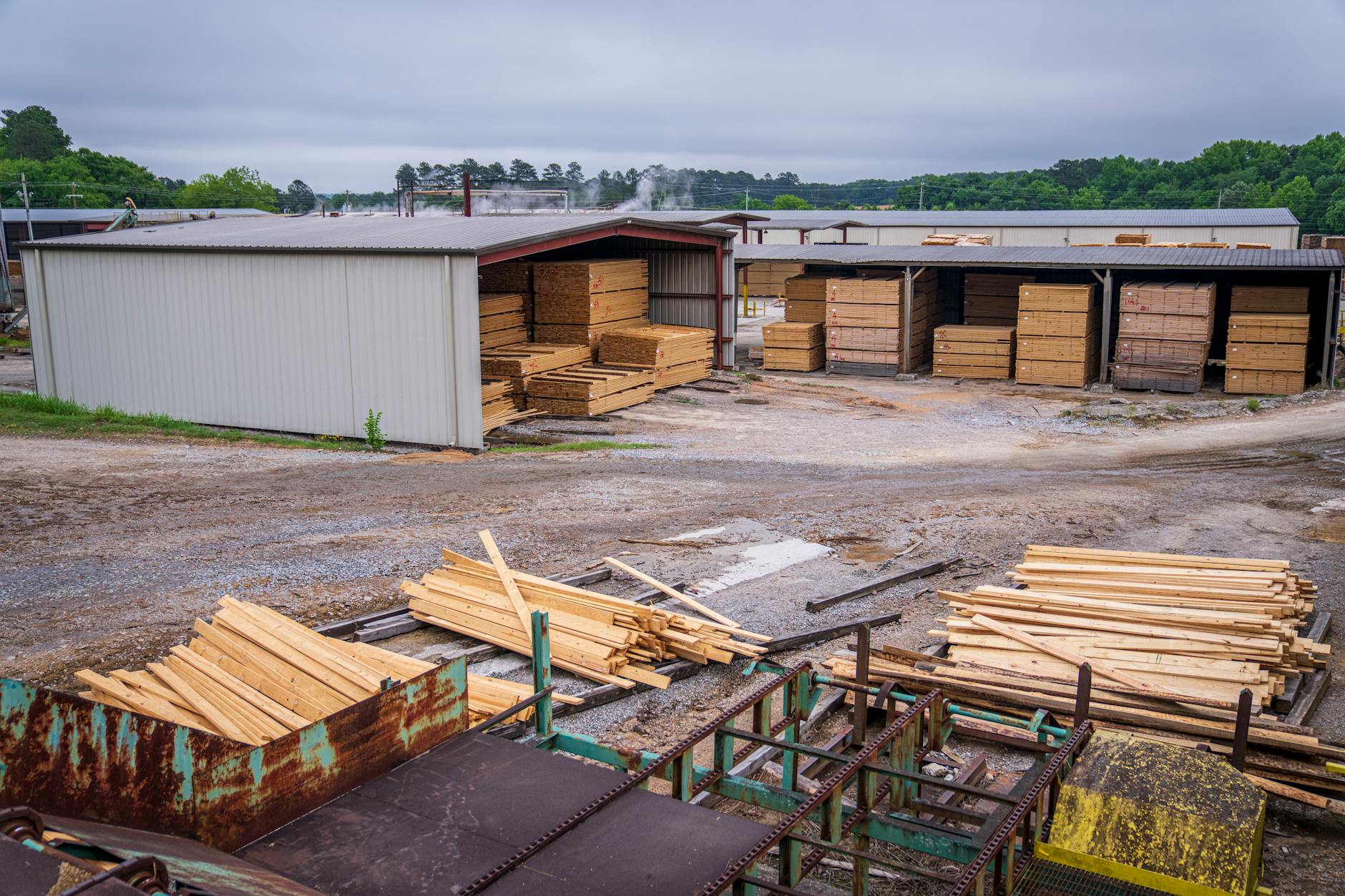
New Hampshire maintains an active sawmill base with over 30 operating facilities, led by Milan Lumber Company producing more than 70 million board feet annually and Britton Lumber Company processing approximately 10 million board feet of Eastern white pine. Yet across North America, sawmills operated at just 64.4% of capacity in Q1 2025, down steadily since 2017, with employment declining for three consecutive quarters through mid-2025.
The disconnect between elevated lumber prices and low capacity utilization stems from compressed margins and limited incentive for expansion. More mills have closed than opened in recent years, with over 1.7 billion board feet of capacity shuttered since Q3 2022. Major closures in 2025 included Canfor’s Estill and Darlington sawmills in South Carolina (350 million board feet capacity, 290 jobs) citing “persistently weak market conditions and sustained financial losses.”
Regional New England mills show mixed conditions. Spruce-fir operations experienced high log inventories during Q1 2025 but achieved “consistently positive EBITDA for the first time in a few years” as lumber prices improved. White pine mills saw stable pricing but declining demand trends, with mills operating diversified, value-added operations performing better. Hardwood mills suffered significantly, with eastern U.S. output down 19% in Q1 2025 compared to the prior year—red oak demand remained “underwhelming” as Asian markets found alternative sources, and industrial log markets softened due to reduced infrastructure spending.
An unusually wet spring extended mud season by three weeks, making forest roads impassable and creating delivery disruptions. This shifted the market from winter oversupply to spring shortages practically overnight, forcing New Hampshire timberland owners to pivot to alternative buyers when primary mills restricted deliveries due to overflowing inventories.
Trade War Devastates Export Markets for Hardwood Lumber
The most dramatic market disruption of 2025 came from escalating international trade tensions that effectively closed or severely restricted major export markets. China imposed 125% tariffs on U.S. hardwood lumber as of May 2025, shutting down a market that previously averaged 35 million board feet monthly. This loss was described as potentially putting parts of the U.S. wood industry at “shutdown risk.”
Canada retaliated against U.S. steel and aluminum tariffs by imposing a 25% tariff on American lumber in March 2025. The European Union proposed 25% tariffs on select U.S. hardwood species including beech, birch, ash, cherry, poplar, and maple (though oak, walnut, hickory, and yellow poplar were exempted), implemented in July 2025. Collectively, approximately 54% of total U.S. hardwood lumber exports by volume became subject to new or increased tariffs in 2025.
The impact has been severe and immediate. U.S. hardwood lumber exports fell 13% by volume through May 2025 compared to 2024. Total export value at risk approaches $970 million across affected markets. While emerging markets like Vietnam, the Middle East, and India show positive trends, they cannot absorb volumes sufficient to replace China’s massive consumption.
In September 2025, the White House imposed new U.S. import tariffs citing “national security” concerns over mill closures and weakened domestic capacity—10% on softwood timber and lumber imports and 25% on upholstered wooden products and kitchen cabinets. This created a peculiar dynamic where both U.S. exports and imports face significant tariff barriers, constraining market flexibility and creating operational uncertainty for producers.
Energy Costs Moderate While Broader Operating Expenses Climb
Diesel fuel prices, critical for logging operations and timber transport, averaged $3.74-3.75 per gallon through August-September 2025, up modestly year-over-year but down substantially from 2024 highs. The Energy Information Administration projects full-year 2025 averages of $3.50-3.61 per gallon, marking the third consecutive year of declining diesel costs and providing some relief to operators.
However, other operating expenses continue climbing relentlessly. Professional logging contractors in Maine reported paying 24% more for key supplies than in 2020, with equipment and truck insurance up 17% and lubricants and film up 30%—far exceeding the 8.4% average consumer inflation over the same period. These rising costs squeeze margins severely, particularly when lumber prices remain stagnant near decade lows and landowner stumpage expectations stay elevated.
Transportation challenges compound cost pressures. The logging industry faces critical truck driver shortages, and H-2B temporary labor visa caps were reached by September 30, 2024—the earliest in program history—constraining time-sensitive operations like tree planting.
Workforce Crisis Threatens Long-Term Industry Viability

The forest products industry sustains 930,000 families nationally and contributes $295 billion annually to the economy, yet faces an existential workforce challenge. The average logging business owner is now 55+ years old, with many planning to exit the business within five years. Meanwhile, a widening disparity exists between people leaving the industry and new worker recruitment.
In response, Congress introduced the bipartisan Jobs in the Woods Act in September 2025, creating grant programs for workforce training in forestry fields through nonprofits, state governments, and colleges. Yet the challenges run deeper than training availability. Younger generations show limited interest in shift work and physically demanding outdoor labor, seeking flexibility incompatible with the early-morning-to-dark logging schedule.
Mill worker shortages limit modernization and growth investments in manufacturing facilities. Equipment operator positions require technical training, but experienced workers are aging out faster than replacements enter the field. Even the U.S. Forest Service faces declining qualified applicants, limiting forest management capacity on public lands.
This labor crisis affects New Hampshire timber prices directly by constraining harvest capacity even when prices justify operations. Landowners with merchantable timber struggle to find available logging contractors, while mills cannot expand production despite elevated lumber prices and limited competition.
Historic Drought and Invasive Species Threaten Forest Health
New Hampshire experienced its driest summer since records began in 1895—130 years ago—with all counties officially in drought by October 2025. Thirty-three percent of the state entered extreme drought status, particularly in the White Mountains and Lakes Region with rain deficits approaching five inches. Patrick Hackley, Director of the NH Division of Forests and Lands, stated bluntly: “We are in unprecedented, uncharted territory right now.”
The drought’s impact extends beyond immediate water supply concerns affecting 196,700 residents under water restrictions. Trees are shutting down early, affecting fall foliage timing and quality. Most critically, stressed trees become far more vulnerable to pests and diseases already threatening commercially important species. Beech trees appear particularly vulnerable, with experts predicting “large swaths of them will die this year, like they did following the 2021 drought.”
Wildfire risk reached levels not seen in decades, prompting Governor Kelly Ayotte to issue a statewide fire ban in September 2025 prohibiting open fires, camping fires, debris burning, and smoking near woodlands. The U.S. Forest Service positioned a Type 1 firefighting helicopter at Lebanon Airport for the first time in 30 years—a 2,500-gallon capacity aircraft costing $10,300 per hour to operate—as 111 acres had already burned by August, trending above typical annual totals.
Emerald ash borer (EAB) now infests all 10 New Hampshire counties after first detection in 2013, with five new towns detected in 2024 including the state’s northernmost detections in Berlin and Jefferson. Ash comprises 6% of NH’s northern hardwood forest—an estimated 25 million trees over 5 inches in diameter plus 750 million seedlings and saplings contributing over $1 million annually to the economy. The future looks “grim” according to experts, with the species facing functional elimination from New Hampshire forests.
Hemlock woolly adelgid (HWA) continues expanding across 120+ towns in every county except Coös, capable of killing trees in 4-10 years. Beech leaf disease (BLD), discovered in NH in 2022, now affects 100+ towns and caused trees to “look quite terrible” in fall 2025 according to UNH Extension experts. Combined with beech bark disease present since the 1960s (already reducing growth 40% and beechnut production 40%), BLD threatens the future of native beech comprising 30% of NH hardwoods. The combination of drought plus beech bark disease plus beech leaf disease creates a particularly “bad combination” likely to trigger significant mortality.
Spongy moth (formerly gypsy moth) entered another cyclical outbreak, defoliating 50,000+ acres in 2022 and continuing through 2024-2025 with 32,000 acres affected in Carroll County alone. Populations are booming across Merrimack, Hillsborough, and Seacoast regions, reducing timber prices through epicormic branching, wood stains, secondary insect damage, and reduced acorn production affecting wildlife and oak regeneration.
Federal Regulatory Changes Have Limited New Hampshire Impact
The Trump Administration issued an executive order in March 2025 directing a 25% increase in domestic timber production for economic development, wildfire protection, and forest health. In April 2025, Agriculture Secretary Brooke Rollins designated 112 million acres of national forests as “high risk” for fire danger, invasive pests, or other concerns, including most of the 800,000-acre White Mountain National Forest.
This designation allows the Forest Service to bypass typical objection processes, streamline certification and permitting, and conduct expedited “sanitation harvests” for insect and disease control while reducing public input opportunities. Federal court rulings in August 2025 approved logging for Peabody West (2,200 acres) and Tarleton Integrated Resource Project (880 acres) under these streamlined procedures.
Environmental groups expressed concern about “ransacking” of public input processes built over decades, while some loggers welcomed “red tape” reduction. However, the practical impact in New Hampshire appears limited. Most NH forests are privately owned (92% of Northeast/Midwest forests are state, private, or non-federal), only 5,000 acres are currently available for logging contracts in White Mountain National Forest, and the local logging industry has limited capacity to expand operations substantially.
State Director Hackley noted he’s “not overly concerned” as long as the National Environmental Protection Act remains in force. For most NH landowners, loggers, and mills, federal policy changes remain largely irrelevant compared to private market dynamics, though the streamlining may modestly increase federal timber supply regionally.
Market Outlook: Navigating Uncertainty Into 2026
As Q4 2025 unfolds, New Hampshire timber prices present a complex picture balancing multiple competing pressures. Quality hardwoods—particularly sugar maple at $400-600/MBF and white ash at $450-700/MBF—command strong prices supported by limited supply, export demand (where still accessible), and domestic furniture and flooring markets. Red oak maintains steady pricing around $350-550/MBF despite Asian market challenges.
Softwoods show more subdued conditions, with white pine stable at $175-200/MBF after declining from 2022 peaks, and spruce/fir flat at $130-160/MBF. Hemlock remains challenged at $40-60/MBF. Pulpwood markets are described as “wide open” with strong demand but soft prices—hardwood pulp at $2-4/ton and softwood at $1-3/ton. The biomass market barely exists at $0-2/ton with only two viable plants in the state, making chipping impractical south of Concord.
Several factors should support prices through 2026. Sawmill capacity utilization at 64.4% limits supply expansion, labor shortages constrain harvest operations, and improving housing demand forecasts (potentially reaching 1.50 million starts by late 2026) suggest strengthening lumber consumption. Tariffs on Canadian imports may redirect domestic mills toward U.S. timber sources, increasing competition for logs.
Conversely, export market collapse removes significant demand, particularly for hardwoods. The 19% decline in eastern U.S. hardwood sawmill output reflects mills shutting capacity in response to weak demand and compressed margins. Trade policy uncertainty creates operational hesitancy among buyers and processors. Most critically, the compound threats from historic drought, emerald ash borer, beech disease complex, hemlock woolly adelgid, and spongy moth defoliation cloud long-term supply sustainability.
For landowners considering timber sales, current market conditions favor quality hardwood stands with good mill access and favorable logging conditions. Competitive bidding through consulting foresters remains essential to capture full market value, as price ranges are wide and location-dependent. Ash should likely be harvested promptly given the species’ grim long-term outlook from EAB, though strong export-driven prices persist where accessible markets remain.
The industry’s ability to navigate 2026 successfully depends largely on factors beyond local control: Federal Reserve interest rate policy affecting housing demand, resolution or escalation of international trade disputes, and weather patterns either extending drought conditions or providing relief. Within New Hampshire, the trajectory of invasive pest spread and forest health deterioration will increasingly determine not just New Hampshire timber prices, but whether sufficient healthy forests remain to sustain a viable commercial timber industry for the next generation.